Output Types on ANFIS Models
Important
All ANFIS model variants in Neuro-Fuzzy Toolbox (ANFIS Variants) support everything presented in this section.
1. Multiple Outputs
Neuro-Fuzzy Toolbox ANFIS models support multiple outputs, which is useful for multivariate regression or multiclass classification problems.
Note
When working with multiple outputs, each output has its own set of consequent parameters. This means the total number of consequent parameters in the model will be larger compared to a single-output model. The model structure adjusts automatically to handle multiple outputs.
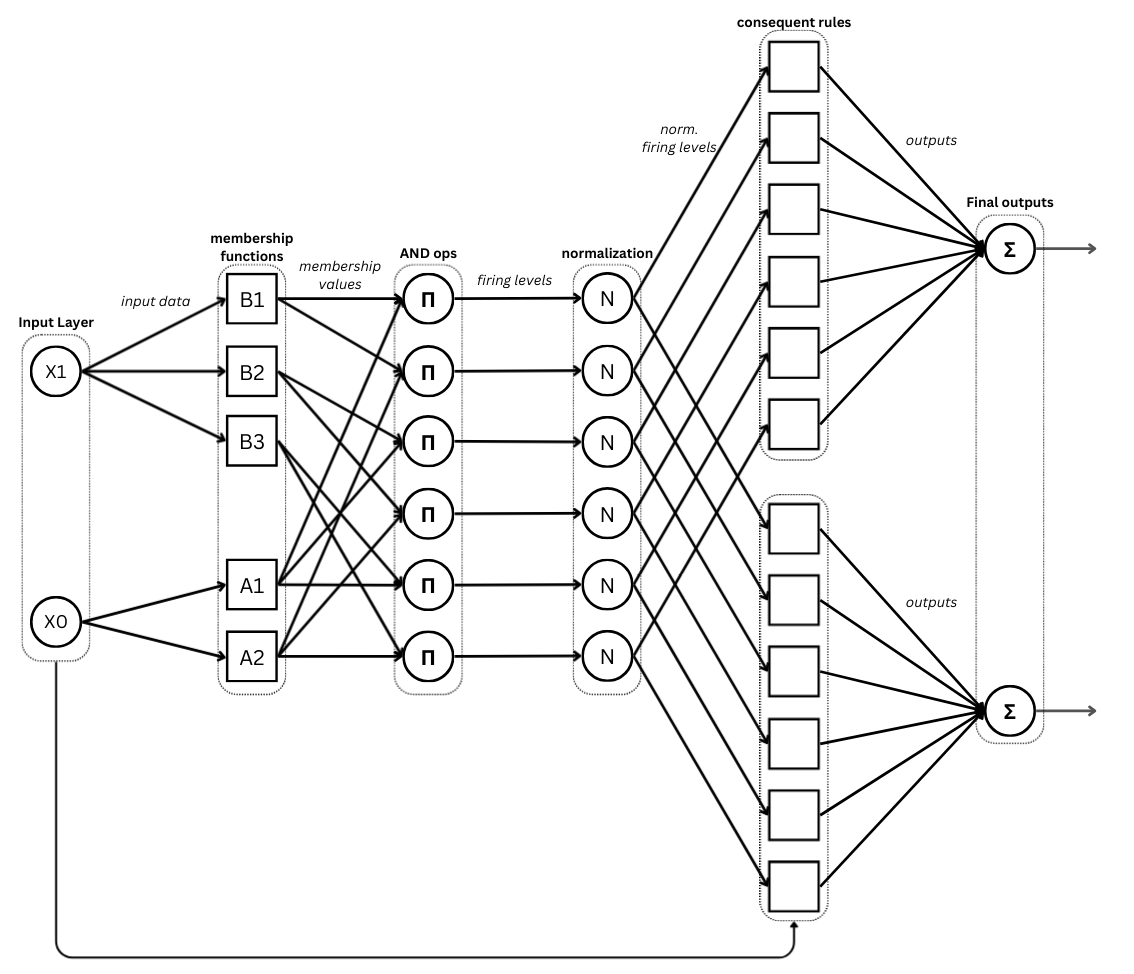
2-output ANFIS model for 2-feature data, with 2 and 3 membership functions per feature respectively (source: authors).
To instantiate a multiple-output model, specify the number of outputs in the outputs parameter:
# Simulating a dataset of 200 samples with 3 features
x_train = 2 * torch.rand(200, 3) - 1  # shape must be (200, 3)

model = nft.h_ANFIS(
    input_size=x_train.shape[1],  # 3 features
    num_mfs=2,                    # 2 MFs per feature
    outputs=2,                    # 2 outputs
    output_type='default'
)
Consequents structure
As noted above, each output has its own set of consequent parameters:
dfs = model.get_consequents_structure()
for i, df in enumerate(dfs):
    print(f"Output {i+1}:\n", df.to_string(), "\n")
Output 1:
               x0        x1        x2
              c0        c1        c2        c3
rule 1 -0.817876 -0.325063  0.288134  0.072033
rule 2  0.640781 -0.439412  0.653194 -0.895495
rule 3  0.174614 -0.089752  0.169705  0.287414
rule 4  0.480423 -0.315141  0.127892  0.296729
rule 5 -0.850491  0.862410 -0.573138  0.291747
rule 6 -0.133427 -0.322040  0.804679 -0.113206
rule 7 -0.307217 -0.596572  0.746054 -0.125493
rule 8  0.845233 -0.224525  0.422965 -0.943465

Output 2:
               x0        x1        x2
              c0        c1        c2        c3
rule 1  0.040619  0.069412 -0.492848 -0.517831
rule 2  0.816708 -0.994996  0.396029 -0.472854
rule 3 -0.648234  0.285575 -0.392293 -0.075887
rule 4  0.087970 -0.225077 -0.607382  0.759483
rule 5 -0.962636 -0.884689 -0.591854  0.752209
rule 6 -0.272644  0.370218  0.999882  0.213316
rule 7 -0.120579 -0.277750  0.769877  0.588212
rule 8  0.475320  0.466696 -0.418957 -0.983339
Outputs
The output tensor shape always follows this convention:
Outputs |
Output tensor shape |
|---|---|
1 |
\((batch\_size, )\) |
2 or more |
\((batch\_size, num\_outputs)\) |
For this example:
model(x_train[:5])
tensor([[ 0.0103, -0.2347],
        [-0.3309,  0.1947],
        [-0.6699, -0.4234],
        [-0.4590,  0.0759],
        [-0.6308, -0.5940]], grad_fn=<SqueezeBackward1>)
whereas for a single-output model:
single_output_model = nft.h_ANFIS(
    input_size=x_train.shape[1],  # 3 features
    num_mfs=2,                    # 2 MFs per feature
    outputs=1,                    # 1 output
    output_type='default'
)

single_output_model(x_train[:5])
tensor([ 0.0103, -0.3309, -0.6699, -0.4590, -0.6308],
       grad_fn=<SqueezeBackward1>)
2. Output Types
Neuro-Fuzzy Toolbox ANFIS models can be instantiated with different output types via the output_type parameter:
‘default’: The model output is the default ANFIS output (the weighted sum of the outputs of each rule).
‘sigmoid’: A sigmoid layer is added at the model output.
‘softmax’: The model’s forward method includes an optional softmax function, activated by the boolean attribute return_probs.
Note
The reason a conditional softmax is used rather than a fixed softmax layer is related to how the cross-entropy loss function is implemented in PyTorch: it computes the softmax internally, so applying it explicitly in the model during training with this loss is unnecessary.
These options change the model structure and the behavior of the predict method, as detailed below.
Default output
With output_type='default', the model behaves as a regressor. The
predict method returns the raw numerical output of the forward method:
# Simulating a dataset of 200 samples with 2 features
x_train = 2 * torch.rand(200, 2) - 1  # shape must be (200, 2)
Instantiating the model with 2 MFs per input feature:
model = nft.h_ANFIS(
    input_size=x_train.shape[1],  # 2 features
    num_mfs=2,                    # 2 MFs per feature
    outputs=1,                    # 1 output
    output_type='default'
)
The predict method returns the raw model output (identical to forward):
model.predict(x_train[:5])
tensor([-0.0858, 0.2285, 0.4727, 0.6517, 0.8427])
model(x_train[:5])
tensor([-0.0858,  0.2285,  0.4727,  0.6517,  0.8427],
       grad_fn=<SqueezeBackward1>)
Sigmoid output
With output_type='sigmoid', each model output behaves as a binary
classifier. A sigmoid layer is appended to the model, so the forward
output is a value in the range (0, 1).
Note
This output type was introduced primarily for experimentation. In practice,
the 'softmax' output type is recommended for any classification problem.
Instantiating the model with 2 MFs per input feature:
model = nft.h_ANFIS(
    input_size=x_train.shape[1],  # 2 features
    num_mfs=2,                    # 2 MFs per feature
    outputs=1,                    # 1 output
    output_type='sigmoid'
)
The forward output:
model(x_train[:5])
tensor([0.4289, 0.5286, 0.2916, 0.4935, 0.5071], grad_fn=<SigmoidBackward0>)
The predict method returns 1 if the positive-class probability exceeds 0.5, and 0 otherwise:
model.predict(x_train[:5])
tensor([0, 1, 0, 0, 1])
This also applies with multiple outputs:
multiple_outputs_model = nft.h_ANFIS(
    input_size=x_train.shape[1],  # 2 features
    num_mfs=2,                    # 2 MFs per feature
    outputs=2,                    # 2 outputs
    output_type='sigmoid'
)
multiple_outputs_model(x_train[:5])
tensor([[0.5557, 0.5229],
        [0.5073, 0.4143],
        [0.4351, 0.5481],
        [0.4641, 0.5223],
        [0.5815, 0.5450]], grad_fn=<SigmoidBackward0>)
multiple_outputs_model.predict(x_train[:5])
tensor([[1, 1],
        [1, 0],
        [0, 1],
        [0, 1],
        [1, 1]])
Softmax output
With output_type='softmax', the model behaves as a multiclass classifier
(when more than 2 outputs are specified). The forward method accepts an
additional return_probs parameter: when set to True, the outputs are
passed through a softmax function and class probabilities are returned;
otherwise, the raw unnormalized logits are returned. The number of classes
must be specified via the outputs parameter.
Important
Using a single output with output_type='softmax' is not meaningful,
as softmax is designed for multiclass classification. Two or more outputs
are required.
Instantiating the model with 3 MFs per feature for a 4-class problem:
model = nft.h_ANFIS(
    input_size=x_train.shape[1],       # 2 features
    num_mfs=3,                         # 3 MFs per feature
    outputs=4,                         # 4 classes
    membership_function=nft.Gaussian_MF,
    output_type='softmax'
)
The forward method returns the class logits by default:
model(x_train[:10])
tensor([[-0.0493, -0.1387, -0.0973, -0.2437],
        [ 0.0523,  0.0660, -0.3045,  0.0437],
        [-0.7400, -0.2403, -0.2109,  0.3169],
        [ 0.2379,  0.2125, -0.4648, -0.3233],
        [ 0.0642, -0.2672,  0.0778, -0.4195],
        [ 0.3088, -0.1348,  0.0422,  0.2339],
        [-0.0446, -0.0012, -0.3213, -0.0296],
        [ 0.0158, -0.2299,  0.0591, -0.3826],
        [-0.1415, -0.1499, -0.2126, -0.3147],
        [-0.1185, -0.2447,  0.3412, -0.1515]], grad_fn=<SqueezeBackward1>)
Passing return_probs=True returns the class probabilities after softmax:
model(x_train[:10], return_probs=True)
tensor([[0.2709, 0.2478, 0.2582, 0.2231],
        [0.2699, 0.2736, 0.1889, 0.2676],
        [0.1384, 0.2282, 0.2350, 0.3984],
        [0.3289, 0.3206, 0.1629, 0.1876],
        [0.2987, 0.2144, 0.3028, 0.1841],
        [0.2998, 0.1924, 0.2296, 0.2782],
        [0.2619, 0.2736, 0.1986, 0.2659],
        [0.2859, 0.2236, 0.2985, 0.1919],
        [0.2657, 0.2635, 0.2474, 0.2234],
        [0.2256, 0.1989, 0.3573, 0.2183]], grad_fn=<SoftmaxBackward0>)
The predict method returns the index of the class with the highest probability:
model.predict(x_train[:10])
tensor([0, 1, 3, 0, 2, 0, 1, 2, 0, 2])